Duplex stainless steel welding operates between two simultaneous failure modes. Too little ferrite in the weld metal and you get stress corrosion cracking and hot cracking risk. Too much ferrite and you get sigma phase embrittlement and 475°C embrittlement. ASME SFA-5.9 Annex A7 and A8.55 contain the code basis for navigating this balance — but the specification’s guidance on nitrogen effects, WRC-1992 prediction, and the PWHT prohibition is rarely extracted and explained in a single place.
This article does exactly that. Every requirement is sourced directly from SFA-5.9 (ER2209 bare wire) and SFA-5.4 (E2209 covered electrode) with specific Annex A clause citations.
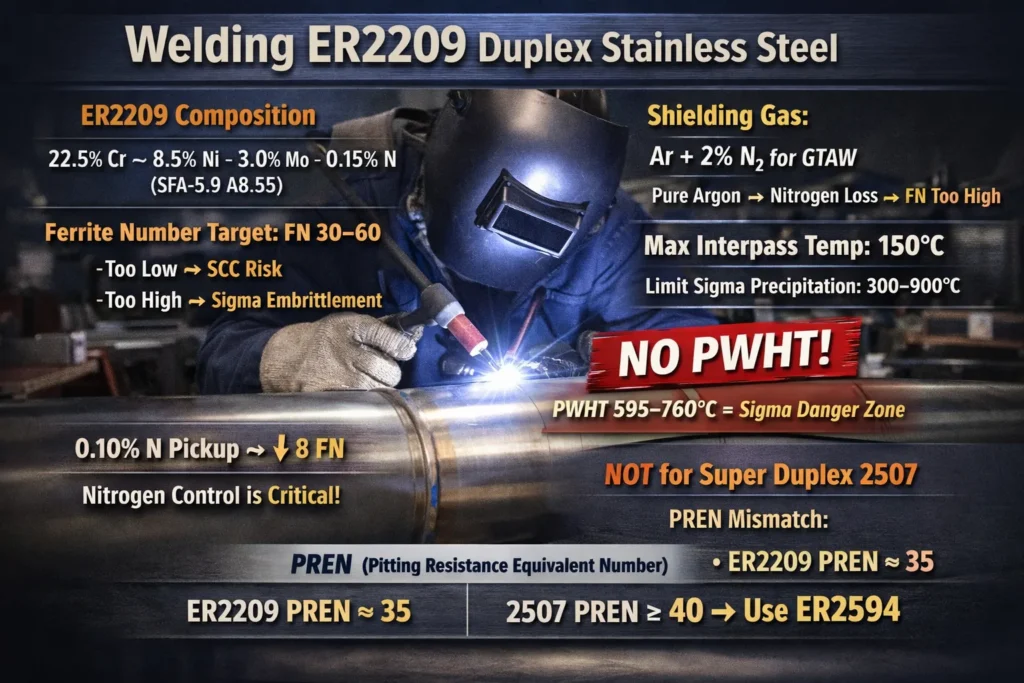
- ER2209 nominal composition: 22.5Cr–8.5Ni–3Mo–0.15N per SFA-5.9 A8.55 — for UNS S31803 and S32205 (2205 duplex)
- Ferrite Number target: FN 30–60 — too low → SCC risk; too high → sigma phase embrittlement
- Shielding gas: Ar+2%N₂ for GTAW — pure argon causes nitrogen loss → ferrite-rich deposit → FN too high
- Maximum interpass temperature: 150°C — half the CS limit — to minimise time in sigma precipitation zone (300–900°C)
- NO PWHT — carbon steel PWHT temperatures (595–760°C) fall directly in the duplex sigma phase precipitation zone
- SFA-5.9 A7.6: each 0.10% nitrogen pickup ≈ −8 FN — nitrogen control is THE critical process variable for duplex
- ER2209 cannot be used for super duplex 2507 (S32750) — PREN mismatch: ER2209 PREN ≈35, 2507 requires PREN ≥40 → use ER2594
ER2209 and E2209: What the Specification Actually Classifies
ASME SFA-5.9 Annex A8.55 provides the complete description: “The nominal composition (wt%) of these classifications is 22.5 Cr, 8.5 Ni, 3 Mo, and 0.15 N, and the all-weld metal microstructure is normally duplex ferritic-austenitic. Filler metal of these classifications is used primarily to weld duplex stainless steels which contain approximately 22% chromium, such as UNS S31803 and S32205.”
SFA-5.4 Annex A7.43 classifies the covered electrode equivalent E2209: “The nominal composition (wt%) of this weld metal is 22.5 Cr, 9.5 Ni, 3 Mo, 0.15 N. Electrodes of this composition are used primarily to weld duplex stainless steel such as UNS S31803 and S32205.”
| Classification | SFA Spec | Process | Cr (nom) | Ni (nom) | Mo (nom) | N (nom) | PREN | Base Metal Target |
|---|---|---|---|---|---|---|---|---|
| ER2209 | SFA-5.9 | GTAW/GMAW/SAW | 22.5% | 8.5% | 3.0% | 0.15% | ~35 | S31803, S32205 (2205 duplex) |
| E2209-15/16/17 | SFA-5.4 | SMAW | 22.5% | 9.5% | 3.0% | 0.15% | ~35 | S31803, S32205 (2205 duplex) |
| E2209T1-1/E2209T1-4 | SFA-5.22 | FCAW | 22.5% | 9.5% | 3.0% | 0.15% | ~35 | S31803, S32205 (gas-shielded FCAW) |
| ER2307 | SFA-5.9 | GTAW/GMAW | 24% | 8% | 0% | 0.15% | ~26 | S32101, S32304 (lean duplex) |
| ER2594 | SFA-5.9 | GTAW/GMAW | 25.5% | 9.2% | 3.5% | 0.25% | ≥40 | S32750, S32760 (super duplex 2507) |
The FN 30–60 Target: Why Both Limits Are Hard Limits
The ferrite number range FN 30–60 for duplex SS weld metal is not arbitrary. Each boundary corresponds to a specific failure mode:
| FN Range | Microstructure | Failure Mode | Mechanism | Consequence |
|---|---|---|---|---|
| FN <25 | Predominantly austenitic | Stress Corrosion Cracking (SCC) | Insufficient ferrite to block chloride-induced SCC crack paths | Catastrophic SCC failure in chloride environments — the primary reason duplex is used |
| FN <3 | Near-fully austenitic | Solidification hot cracking | No ferrite to interrupt continuous austenitic grain boundaries | Weld centreline cracking during solidification — same as standard austenitic SS risk |
| FN 30–60 | Balanced α + γ | None — TARGET ZONE | Sufficient ferrite for SCC resistance; insufficient for embrittlement | Optimal combination of strength, toughness, SCC resistance, and corrosion performance |
| FN >65 | Ferrite-dominant | Sigma phase embrittlement above 300°C | Fe-Cr σ phase precipitates at α/γ interfaces — brittle intermetallic | Impact energy collapses; Charpy 200 J → <10 J |
| FN >65 | Ferrite-dominant | 475°C embrittlement | Cr-rich α’ spinodal decomposition at ~475°C | Hardness increases, ductility loss, corrosion resistance reduction |
The Nitrogen Variable: Why Shielding Gas Is the Critical Process Control
SFA-5.9 Annex A7.6 contains a statement that defines the entire approach to duplex SS GTAW shielding gas selection: “High-nitrogen pickup can cause a typical 8 FN deposit to drop to 0 FN. A nitrogen pickup of 0.10% will typically decrease the FN by about 8.”
For a duplex SS weld metal starting at FN 45 (mid-target range), a nitrogen pickup of only 0.30% (30% excess atmospheric nitrogen exposure) would reduce the FN to approximately 21 — below the FN 25 minimum and into the SCC-susceptible range. Conversely, nitrogen loss through pure argon shielding causes ferrite-rich deposits moving toward the sigma risk zone.
| Shielding Gas | Nitrogen Effect | Typical FN Impact | Recommendation |
|---|---|---|---|
| Pure Argon (SG-A) | Nitrogen loss from weld pool | ↑ FN — too ferritic risk | NOT recommended for duplex GTAW fill passes |
| Ar + 2% N₂ | Nitrogen maintained near wire analysis | FN stays near target | RECOMMENDED for duplex GTAW fill passes |
| Pure Argon (back-purge) | Neutral on root side | Minimal effect | Acceptable for root back-purge on pipe |
| Ar + 20–25% CO₂ (GMAW) | Carbon pickup risk; avoid for duplex | Compromises corrosion resistance | NOT recommended for duplex GMAW |
| Ar + 2% N₂ + He | Improved penetration; maintained N | FN near target; better fusion | For thick section duplex or automatic GTAW |
Why PWHT Is Prohibited — The Sigma Phase and 475°C Embrittlement Zones
Standard carbon steel PWHT temperatures — typically 595–760°C for P-No.1 to P-No.4 steels — fall directly within the duplex stainless sigma phase precipitation zone (approximately 550–950°C). Sigma phase (Fe-Cr intermetallic compound) precipitates preferentially at ferrite/austenite interfaces. Its formation causes dramatic ductility loss: Charpy impact energy can drop from 200+ J to near zero in just 2–4 hours at 700°C for a typical duplex SS.
This creates a fundamental problem for composite structures containing both carbon steel (requiring PWHT) and duplex SS: the CS PWHT temperature will embrittle the duplex component. The engineering solution is either to avoid combining these materials on structures requiring PWHT, or to use a nickel-alloy barrier layer that tolerates PWHT without sigma formation (though this comes with its own constraints). Per SFA-5.4 A7.43, duplex SS electrodes are not to be subjected to PWHT — the no-PWHT requirement is explicitly part of the duplex SS welding approach.
WPS Requirements and Practical Procedure Controls
| Parameter | Requirement | Code Basis | Why It Matters |
|---|---|---|---|
| Preheat | None required (ensure above dew point) | SFA-5.4/5.9 — no preheat table for duplex | No martensite forms; HIC not a concern for duplex |
| Max interpass temperature | 150°C maximum | SFA-5.9 / Construction code tables | Limits time in 300–900°C sigma precipitation zone during multi-pass welding |
| Shielding gas (GTAW fill) | Ar + 2%N₂ per SFA-5.32 | SFA-5.9 A7.6 nitrogen loss data | Maintains FN in 30–60 target; prevents ferrite-rich deposits |
| Back-purge gas (pipe GTAW) | Pure Argon (SG-A, SFA-5.32) | Standard duplex pipe practice | Prevents oxidation of root bead; pure Ar acceptable for root |
| PWHT | NONE — contraindicated | SFA-5.4 A7.43 / Material metallurgy | PWHT temperatures (595–760°C) precipitate sigma phase |
| FN verification | Measure with Feritscope per AWS A4.2 | SFA-5.9 A7.4 FN measurement | Production weld FN confirmation; target FN 30–60 |
| Heat input | Moderate — typically 0.5–2.5 kJ/mm | Industry guidance; no specific code limit | High heat input (>3 kJ/mm) extends time in sigma zone; promotes σ precipitation |
Frequently Asked Questions
Why is PWHT (post-weld heat treatment) not recommended for duplex stainless steel welds?
Duplex SS is uniquely susceptible to sigma (σ) and chi (χ) phase formation in the temperature range 300–900°C. PWHT temperatures that would stress-relieve carbon steel (595–760°C) fall squarely within the most damaging sigma phase precipitation zone for duplex SS. Sigma phase embrittlement can reduce Charpy impact energy from 200+ J to near zero in hours of exposure. Therefore PWHT is contraindicated — the correct approach is no PWHT, with interpass temperature control to limit time-at-temperature during welding.
What shielding gas should be used for GTAW of duplex stainless steel with ER2209?
Argon with 2% nitrogen (Ar+2%N₂) is the recommended shielding gas for GTAW of duplex stainless steel. Per SFA-5.9 and the WRC data on nitrogen effects, nitrogen is a powerful austenite stabiliser (approximately 8 FN loss per 0.10% nitrogen pickup per SFA-5.9 A7.6). The 2% N₂ addition maintains the weld deposit nitrogen content close to the wire analysis and prevents ferrite-rich deposits that would result from nitrogen loss during welding. Pure argon is used as a back-purge for root passes on duplex pipe.
What is the maximum interpass temperature for duplex stainless steel welding?
Maximum interpass temperature for duplex SS welding with ER2209 or E2209 is 150°C — significantly lower than the 300°C maximum for carbon steel or Cr-Mo steels. This tight limit serves two purposes: it limits time in the 300–900°C sigma phase precipitation zone during multi-pass welding, and it prevents excessive austenite grain growth in the HAZ that would reduce toughness and corrosion resistance in the heat-affected zone.
What is the difference between ER2209 and ER2594 for duplex stainless welding?
ER2209 (22.5Cr-8.5Ni-3Mo-0.15N, PREN ≈35) is for standard duplex stainless steels like 2205 (UNS S31803, S32205) per SFA-5.9 A8.55. ER2594 (25.5Cr-9.2Ni-3.5Mo-0.25N, PREN ≥40) is for super duplex stainless steels like 2507 (UNS S32750) per SFA-5.9 A8.58. Using ER2209 for super duplex base metal creates a PREN mismatch — the weld zone would corrode preferentially in aggressive chloride service. Always match the filler PREN to the base metal specification.
Can duplex stainless steel be welded without preheat?
Yes — no preheat is required or recommended for standard duplex SS welding with ER2209. The austenite-ferrite microstructure of duplex SS does not form martensite on cooling (unlike ferritic or martensitic SS), and the high nitrogen and molybdenum content makes hydrogen-induced cracking essentially non-existent at ambient temperatures. The only preheat consideration is ensuring the joint area is above ambient dew point to prevent moisture condensation, which could cause porosity.
How does nitrogen addition to shielding gas affect duplex SS ferrite number?
Per SFA-5.9 A7.6, nitrogen is a potent austenite stabiliser that reduces ferrite content: approximately 8 FN decrease per 0.10% nitrogen pickup. If pure argon is used (no N₂ addition), nitrogen can be lost from the weld pool during GTAW, pushing the deposit toward higher ferrite — potentially above FN 60. If the shielding gas has too much N₂ or the base metal is high-nitrogen duplex, nitrogen gain can push the deposit below FN 30 toward fully austenitic deposits with hot cracking risk. Ar+2%N₂ balances these competing effects.
📦 Recommended Products
As an Amazon Associate, WeldFabWorld earns from qualifying purchases at no extra cost to you.
ER308L per SFA-5.9 for austenitic 304L stainless — useful reference product for understanding FN targets across the austenitic/duplex SS family. E308L targets FN 3–8 while ER2209 targets FN 30–60.
ER316L per SFA-5.9. For 316L GTAW applications. FN target FN 0–2 for cryogenic, FN 3–8 for standard service — comparison with duplex FN 30–60 target illustrates the fundamental microstructure difference between austenitic and duplex SS.
ER309L per SFA-5.9 for CS-to-SS dissimilar joints. FN target >8 FN — the buffer layer for dissimilar CS-to-SS joints. When joining carbon steel to duplex SS, ER309L is still used as the CS-side butter layer before ER2209 fill passes.
🔗 Related Articles
When ER2209 is not enough — super duplex 2507 requires PREN ≥40 and stricter 100°C interpass limit.
E2209T1-1 and E2209T1-4 FCAW duplex electrodes — the FCAW equivalent of ER2209 for production fabrication.
Using the WRC-1992 diagram to predict duplex and austenitic SS ferrite number from deposit chemistry.
Joining carbon steel to duplex SS — the ER309L butter layer approach.
Decoding SG-A (argon) and Ar+N₂ mixed gas classifications for duplex SS GTAW WPS documentation.