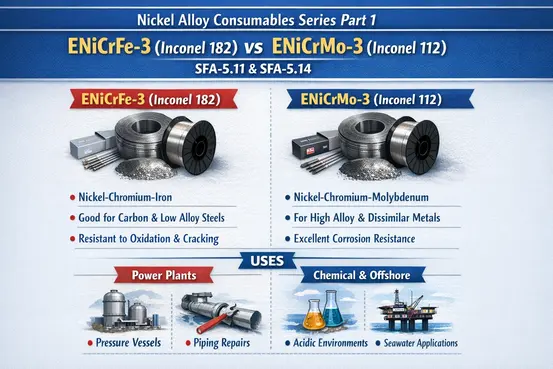
The nickel alloy electrode family in ASME Section II Part C spans two SFA specifications — SFA-5.11 for covered SMAW electrodes and SFA-5.14 for bare wire (GTAW, GMAW) — and contains over 40 distinct classifications. For most engineers, the critical choice is between two families: ENiCrFe-3 (Alloy 182) for Inconel 600-family base metals, and ENiCrMo-3 (Alloy 625 / Alloy 112) for Alloy 625 and dissimilar high-alloy applications.
SFA-5.14 was revised in its entirety in the 2025 ASME edition — updated to match AWS A5.14/A5.14M:2023. If your WPS references SFA-5.14 bare wire classifications, verify the format and any new classifications against the 2025 edition. This article covers the complete picture from both specifications, drawing directly from the Annex A guidance that governs intended use.
- ENiCrFe-3 (Alloy 182): 65Ni–15Cr–8Fe–7.5Mn–2Nb+Ta — for Alloy 600 (N06600) welding and steel-to-Ni-alloy joints. Service: cryogenic to ~480°C
- ENiCrMo-3 (Alloy 625 / Alloy 112): 60Ni–22Cr–9Mo–5Fe–3.5Nb+Ta — for Alloy 625 (N06625) and overlay cladding. Service: cryogenic to ~540°C
- The 9% molybdenum in ENiCrMo-3 is the single most important compositional difference — it provides resistance to reducing acid environments and pitting that ENiCrFe-3 completely lacks
- Both are F-Number 43 in ASME Section IX QW-432 — one PQR qualifies all F-43 filler metals for the same P-number base metal
- SFA-5.14 revised in 2025 entirety — verify bare wire (ERNiCrFe-3, ERNiCrMo-3) classification format if updating WPS documents
- ENiCrFe-3 (Alloy 182) is PWSCC-susceptible in nuclear PWR service — replaced by ENiCrFe-7 (Alloy 52M, ~30%Cr) per Code Case N-504
- ENiCrMo-3 overlay (ERNiCrMo-3, SFA-5.14) on carbon steel vessels requires minimum 2-layer deposit; verify final layer chemistry per ASME VIII UHA-44
SFA-5.11 and SFA-5.14: What Each Covers
The two nickel alloy SFA specifications are complementary — one for covered SMAW electrodes, one for bare wire used in GTAW, GMAW, PAW, and related processes:
| Specification | Process | Electrode Form | Prefix | Key 2025 Change | F-Number |
|---|---|---|---|---|---|
| SFA-5.11 | SMAW | Covered electrode | E (e.g., ENiCrFe-3) | No full revision in 2025 | F-43 |
| SFA-5.14 | GTAW / GMAW / PAW | Bare wire or rod | ER (e.g., ERNiCrMo-3) | Revised in entirety — 2025 | F-43 |
ENiCrFe-3 (Alloy 182) — What SFA-5.11 Annex A7.4.3 States
SFA-5.11 Annex A7.4.3 provides the complete description of ENiCrFe-3 intended use in direct code language. The nominal composition is 65Ni, 15Cr, 8Fe, 7.5Mn, and 2Nb+Ta. The high manganese content (7.5% — the highest of any common nickel alloy electrode) is characteristic of Alloy 182 and distinguishes it from ENiCrMo-3.
Per Annex A7.4.3, these electrodes are designed for:
- Welding nickel-chromium-iron alloys (Alloy 600, N06600 family — ASTM B163, B166, B167, B168)
- Welding the clad side of joints in steel clad with nickel-chromium-iron alloy
- Surfacing steel with nickel-chromium-iron weld metal
- Joining steel to other nickel-base alloys (dissimilar joints)
- Service temperatures from cryogenic to approximately 480°C (900°F)
The GTAW/GMAW bare wire equivalent is ERNiCrFe-3 (SFA-5.14, also known commercially as Alloy 82 — note: different alloy number from covered electrode Alloy 182). The composition is essentially identical. Both are F-43.
ENiCrMo-3 (Alloy 625 / Alloy 112) — What SFA-5.11 Annex A7.8.3 States
SFA-5.11 Annex A7.8.3 classifies ENiCrMo-3 with nominal composition 60Ni, 22Cr, 9Mo, 5Fe, and 3.5Nb+Ta. The 9% molybdenum is the defining difference from ENiCrFe-3 and is the basis for ENiCrMo-3’s significantly better corrosion resistance in reducing environments, chloride-containing media, and seawater.
Per Annex A7.8.3, designed for:
- Welding nickel-chromium-molybdenum alloys — specifically Alloy 625 (N06625, ASTM B443, B444, B446)
- Joining nickel-base alloys to steel (dissimilar joints)
- Surfacing steel with nickel-chromium-molybdenum weld metal (corrosion-resistant overlay)
- Service from cryogenic to approximately 540°C (1000°F)
Complete Chemistry and Application Comparison
| Property | ENiCrFe-3 (Alloy 182) | ENiCrMo-3 (Alloy 625 / 112) |
|---|---|---|
| SFA Specification | SFA-5.11 (SMAW covered) | SFA-5.11 (SMAW) / SFA-5.14 (bare wire) |
| UNS Number | W86182 | W86112 |
| Ni (nominal) | ~65% | ~60% |
| Cr (nominal) | ~15% | ~22% (higher — better passive film) |
| Mo (nominal) | 0% — none | ~9% — KEY difference |
| Fe (nominal) | ~8% | ~5% |
| Mn (nominal) | ~7.5% (high — characteristic) | ≤1% (low) |
| Nb+Ta (nominal) | ~2% | ~3.5% |
| Target base metal | Alloy 600 (N06600) | Alloy 625 (N06625) |
| ASTM specifications | B163, B166, B167, B168 | B443, B444, B446 |
| Max service temp (SFA Annex A) | ~480°C (A7.4.3) | ~540°C (A7.8.3) |
| Cryogenic service | Yes — cryogenic capable | Yes — cryogenic capable |
| PWSCC resistance | Poor — only 15%Cr | Better — 22%Cr + Mo |
| Reducing acid resistance | Limited — no Mo | Good — 9% Mo |
| Seawater / offshore | Acceptable | Preferred |
| F-Number (ASME IX) | F-43 | F-43 |
| GTAW bare wire equiv. | ERNiCrFe-3 (SFA-5.14) | ERNiCrMo-3 (SFA-5.14) |
Nuclear Application: Why ENiCrFe-3 (Alloy 182) Was Replaced in PWR Service
Alloy 182 (ENiCrFe-3) was the standard SMAW electrode for nuclear PWR reactor vessel nozzle welds for decades. Beginning in the 1990s, Primary Water Stress Corrosion Cracking (PWSCC) was discovered at multiple plants in Alloy 182 weld metal — most critically at reactor vessel head penetration nozzles and pressuriser heater sleeve welds.
The metallurgical mechanism: with only 15% chromium, the passive oxide film (Cr₂O₃) on ENiCrFe-3 weld metal is marginally stable in PWR primary water chemistry (hydrogenated, high-temperature, high-purity water at ~300°C). Residual tensile welding stresses provide the necessary stress driving force. The result is inter-granular stress corrosion cracking progressing through the weld metal over years of service.
The industry solution, formalised in ASME Code Case N-504 and referenced in the MRP-2 programme, is ENiCrFe-7 (Alloy 52) and its improved variant ENiCrFe-13 (Alloy 54M) — both carrying approximately 29–30% chromium. The higher Cr content creates a far more stable passive film in PWR water chemistry. SFA-5.14 (revised 2025) classifies both ERNiCrFe-7 and ERNiCrFe-13. For the detailed comparison of nuclear Ni-alloy transitions, see our Nickel Alloy Consumables Series Part 2: Alloy 52M and 54M.
WPS Recording Requirements for SFA-5.11 and SFA-5.14 Nickel Alloy Electrodes
| WPS Field | What to Record | Common Error |
|---|---|---|
| SFA Specification | SFA-5.11 (for SMAW) or SFA-5.14 (for GTAW/GMAW) with 2025 edition year | Recording SFA-5.14 without noting 2025 revision — some classification format changes apply |
| AWS Classification | Full classification: ENiCrFe-3, ENiCrMo-3, ERNiCrMo-3, etc. | Recording only ‘nickel alloy’ or ‘Inconel 625’ — does not constitute a valid SFA classification |
| F-Number | F-43 (both SFA-5.11 and SFA-5.14 Ni-alloy electrodes) | Omitting F-number — required for procedure qualification matrix under ASME IX QW-404 |
| A-Number | A-9 (Ni-Cr-Mo-Fe type) per ASME IX QW-442 | Omitting A-number — required for deposited weld metal analysis grouping |
| Shielding gas (GTAW) | SFA-5.32, SG-A (Argon ≥99.5%) per SFA-5.32 classification | Writing ‘argon’ without the SFA-5.32 classification — shielding gas is an essential variable |
| Preheat | Per base metal P-number construction code — not a Section II Part C requirement | Applying stainless steel no-preheat rule to nickel alloy-to-CS dissimilar joint — CS side may need preheat |
Frequently Asked Questions
What is the difference between ENiCrFe-3 (Alloy 182) and ENiCrMo-3 (Alloy 625 / Alloy 112)?
ENiCrFe-3 (Alloy 182) per SFA-5.11 has composition 65Ni-15Cr-8Fe-7.5Mn-2Nb+Ta. It is used for welding nickel-chromium-iron alloys (Inconel 600 family) and can be used cryogenic to about 480°C service. ENiCrMo-3 (Alloy 625/112) per SFA-5.11 has composition 60Ni-22Cr-9Mo-5Fe-3.5Nb+Ta. It is used for Alloy 625 base metal and for dissimilar applications where higher Mo content provides better corrosion resistance. The key difference is molybdenum (none in 182, 9% in 625) which gives ENiCrMo-3 significantly better resistance to reducing corrosion environments.
What F-Number do nickel alloy electrodes (SFA-5.11) have in ASME Section IX?
All covered nickel alloy electrodes classified under SFA-5.11 are F-Number 43 in ASME Section IX QW-432. Bare nickel alloy wires and rods under SFA-5.14 are also F-Number 43. This means a single WPS/PQR qualification using any F-43 filler metal qualifies welding with any other F-43 filler metal from either SFA-5.11 or SFA-5.14, provided the base metal P-number and other essential variables are covered.
Can ENiCrMo-3 (Alloy 625) be used to weld carbon steel to nickel alloy?
Yes. Per SFA-5.11 A7.8.3, ENiCrMo-3 electrodes can be used for welding nickel-base alloys to steel (dissimilar joints). The high Ni content (60%+) maintains austenitic microstructure even with significant CS dilution. Alloy 625 (ERNiCrMo-3 bare wire, SFA-5.14) is widely used as a butter/overlay material on carbon steel pressure vessels for corrosion-resistant cladding in oil & gas service.
What is the maximum service temperature for ENiCrFe-3 (Alloy 182) per SFA-5.11?
Per SFA-5.11 Annex A7.4.3, ENiCrFe-3 may be used from cryogenic temperatures to about 480°C (900°F). Above 480°C, the weld metal does not exhibit optimum oxidation resistance and strength. For higher temperature nickel-alloy service (above 820°C), ENiCrCoMo-1 (Alloy 617) or similar high-temperature Ni alloys should be considered.
Why is ENiCrFe-3 (Alloy 182) no longer specified for nuclear PWR vessel nozzle welds?
Alloy 182 (ENiCrFe-3) proved susceptible to Primary Water Stress Corrosion Cracking (PWSCC) in PWR nuclear environments. With only 15% chromium, the passive oxide film is marginally stable in high-temperature reduced primary water. Multiple plants experienced PWSCC at reactor vessel head nozzle welds made with Alloy 182. The industry transition has been toward Alloy 52M (ERNiCrFe-7, SFA-5.14 2025) which has ~30% Cr for a much more stable passive film — though at the cost of significantly higher hot cracking susceptibility.
What is the GTAW bare wire equivalent of ENiCrFe-3 and ENiCrMo-3?
Per ASME SFA-5.14 (revised in 2025): ERNiCrFe-3 is the GTAW/GMAW equivalent of ENiCrFe-3 (Alloy 82 — note different Alloy number from Alloy 182). ERNiCrMo-3 is the GTAW/GMAW equivalent of ENiCrMo-3 (Alloy 625). Both are F-Number 43 in ASME IX and have the same base composition as the covered electrode versions from SFA-5.11.
What shielding gas is used for GTAW with ERNiCrMo-3 (Alloy 625)?
Pure argon (SFA-5.32 Classification SG-A) is the standard shielding gas for GTAW of nickel alloys including ERNiCrMo-3. Addition of hydrogen (Ar+H₂ mixtures) can improve bead wetting and reduce porosity for some applications but requires specific WPS qualification. CO₂ additions are not recommended for nickel alloy GTAW — they can cause carbon pickup and reduce corrosion resistance. Always record the shielding gas classification per SFA-5.32 on the WPS.
📦 Recommended Products
As an Amazon Associate, WeldFabWorld earns from qualifying purchases at no extra cost to you.
While nickel alloy electrodes require specialist industrial supply, ER308L is used for the stainless fill passes over ENiCrFe-3 / ENiCrMo-3 butter layers in dissimilar CS-to-SS joints. Essential companion product for multi-process dissimilar welding procedures.
ER316L per SFA-5.9 — used for Type 316L fill passes in dissimilar joints where ENiCrMo-3 is the buffer layer. Molybdenum-bearing stainless for chloride service piping systems.
ER309L per SFA-5.9 — the standard dissimilar welding GTAW wire for CS-to-SS joints. Used alongside ENiCrFe-3 and ENiCrMo-3 in multi-layer dissimilar procedures on process piping systems.
🔗 Related Articles
How ENiCrFe-7 (30%Cr) replaced Alloy 182 in nuclear PWR applications — PWSCC mechanism and Code Case N-504.
The companion article on CS-to-SS dissimilar joints — E309L chemistry, dilution, and the two-layer sequence.
Ferrite control in duplex SS welds — relevant when nickel alloy electrodes are used for dissimilar duplex joints.
Full SFA framework, P-numbers, F-numbers, and 2025 edition change summary.
SFA-5.14 revised in entirety in 2025 — classification format and new additions including Alloy 52M/54M.